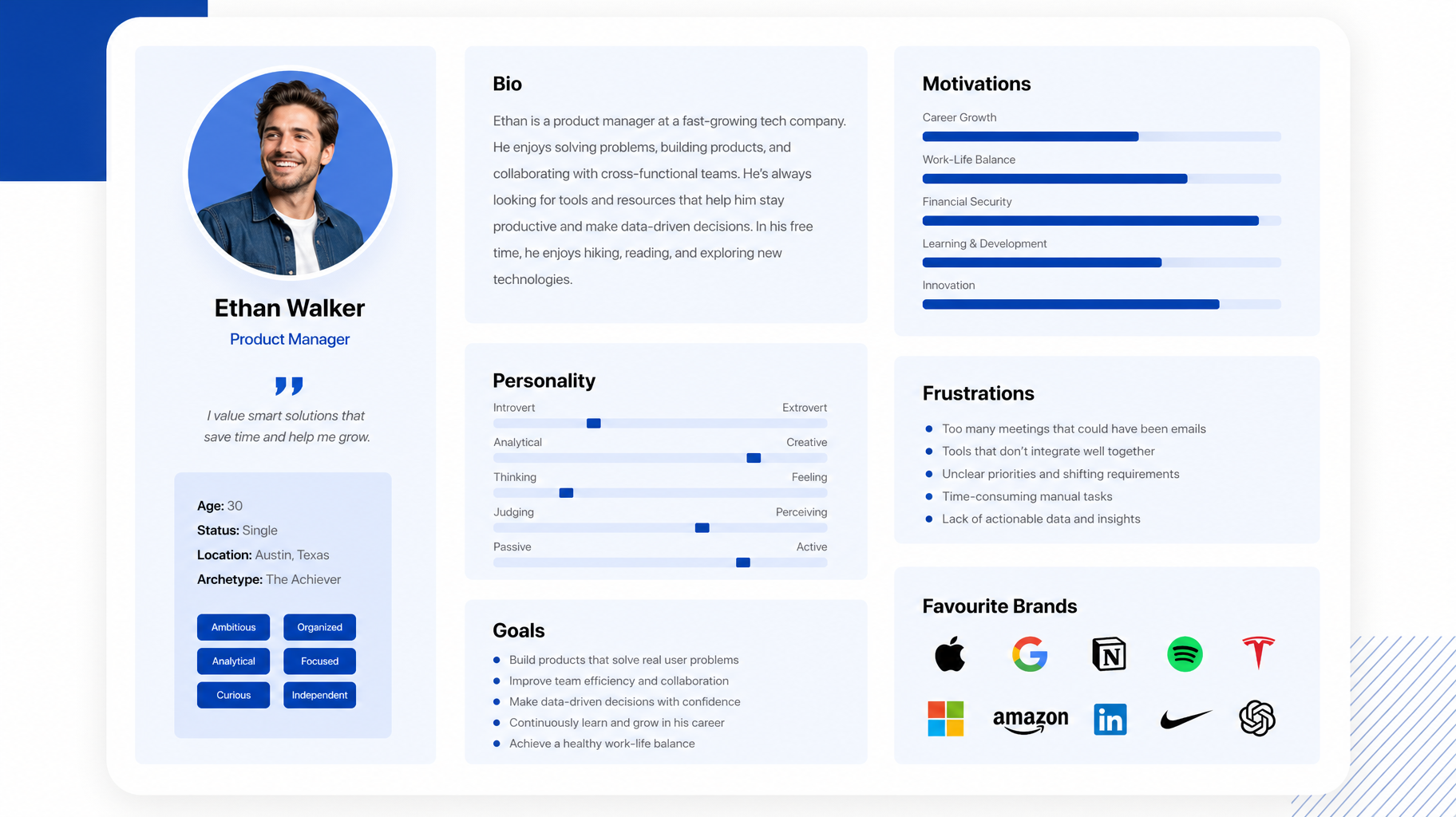
AI UX is changing how user research and persona development happen across digital products. What once required weeks of interviews, analysis, and synthesis can now be accelerated through artificial intelligence. But speed does not always equal understanding. A recent UXPA Journal study explored how AI can support UX persona development and found something important: AI can expand research, but it cannot replace human truth, emotional context, or lived experience.
This is where the conversation around AI UX becomes more serious. The question is no longer whether designers should use AI. The better question is how to use AI without losing the human insight that makes UX valuable in the first place.
How AI is changing UX persona development
User personas have always helped design teams understand who they are building for. A strong UX persona gives a team more than demographics. It shows user goals, frustrations, behaviors, priorities, and context.
AI can make research faster, but only real users can make it true.
What the UXPA study found
The study compared personas created from real user interviews with personas created from AI responses. Researchers asked AI tools the same questions they asked human participants, then compared the results.
AI produced polished, complete, and confident answers. Human participants gave messier responses, but those responses revealed more authentic priorities, limitations, and real-world context.
AI can help generate broader persona inputs, but human interviews are still needed to validate what is accurate, useful, and emotionally real.
Where AI UX performs well
AI performed best when it helped researchers expand the field of possibilities. It could suggest ideas, organize information, and provide broad context that helped researchers ask better follow-up questions.
Speed, scale, synthesis, idea generation, broader research prompts.
Emotion, memory, lived context, priorities, hesitation, and truth.
This is the best use of AI UX in research. AI should not replace the user. It should help researchers prepare better, ask better questions, and see what might be missing.
Where AI still falls short
The study also showed that AI often sounds too perfect. It over-explains, fills in gaps with confidence, and creates personas that may feel professional but not always realistic.
1. AI over-explains
AI often gives too much information without clearly showing what matters most.
2. AI lacks lived context
It cannot fully understand the pressure, habits, limitations, or emotional reality of real users.
3. AI sounds too polished
Real users hesitate, contradict themselves, and reveal insight through imperfect conversation.
4. AI struggles to prioritize
It can list many possibilities, but it does not always know which one matters most in real life.
The Vector Persona model
The study introduced Vector Personas as a hybrid process. Instead of choosing between AI and human research, teams combine both.
| Layer | Role | Value |
|---|---|---|
| Human interviews | Reveal truth | Authentic user context |
| AI synthesis | Expand scope | More complete research inputs |
| Validation | Check accuracy | Stronger UX persona |
What this means for designers
For designers, this research makes one thing clear. AI is not a shortcut around users. It is a tool that can help teams prepare, expand, compare, and synthesize.
A strong UX persona should still be grounded in real people. AI can help make that process faster and broader, but the final decisions need to be shaped by human validation.
The future of AI UX is not automation alone. It is better human understanding at scale.
Final thought
AI UX is moving quickly, and persona development is evolving with it. The UXPA study shows that AI can support research, but it cannot replace lived experience.
The strongest UX persona is not only AI-generated or only human-generated. It is built through a smarter process where AI helps researchers see more, and real users help teams understand what matters.
Lauer, Claire et al. Leveraging AI Toward the Development of Vector Personas for UX Research, Journal of User Experience, Vol. 20, Issue 4, August 2025.