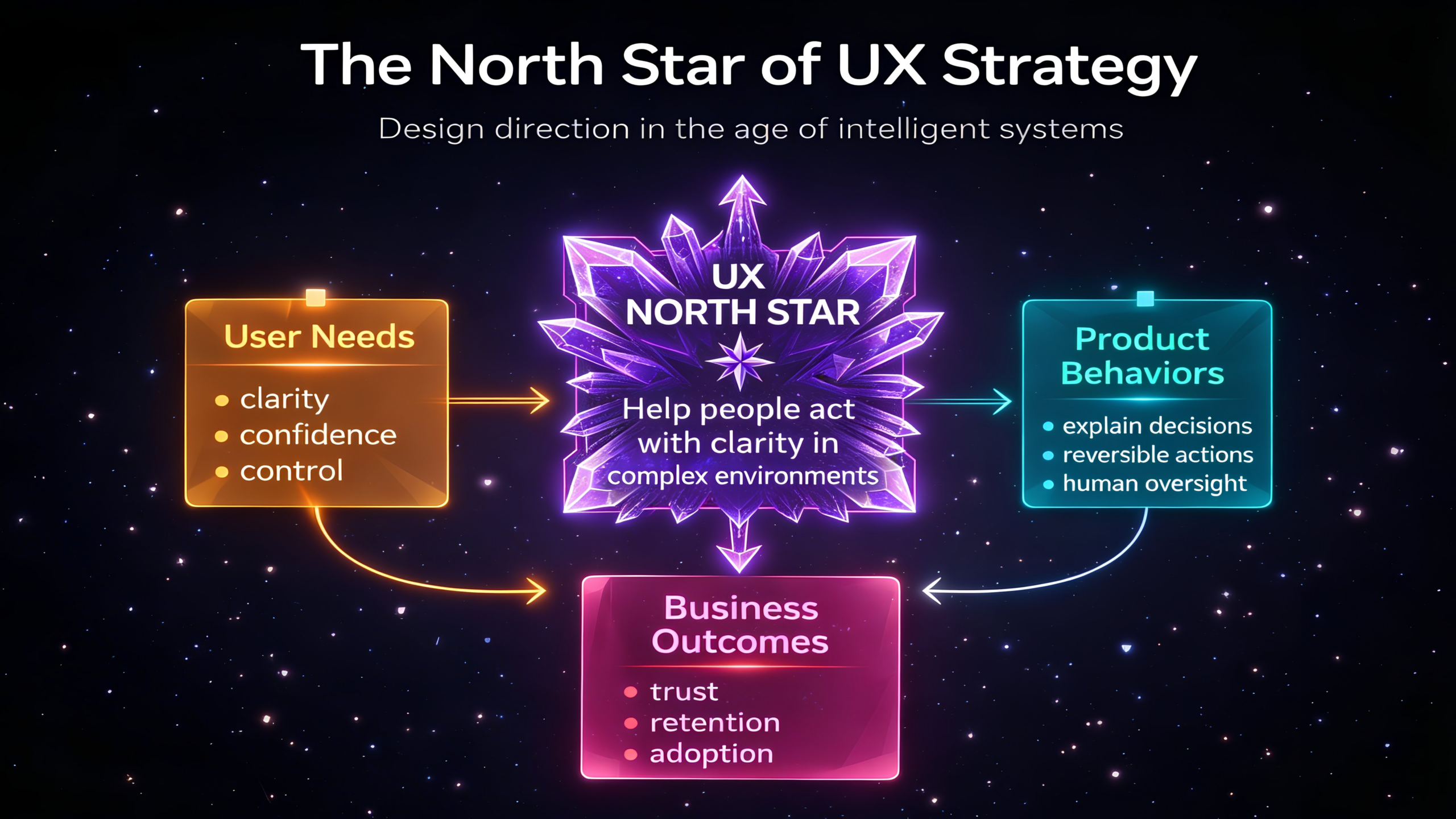
In 2026, products are no longer simply places people visit. They are systems that respond, predict, and adapt. In that shift, UX strategy becomes less about adding more features and more about defining how a product behaves around a human being.
A North Star strategy is a form of discipline. It defines what the experience must protect even as priorities change, technologies evolve, and teams move faster than they can always explain.
It started as a navigational truth
The phrase comes from the sky. Polaris sits close to Earth’s northern axis and appears steady while other stars drift. For centuries, travelers used it to keep their bearings.
It never promised a route. It offered orientation.
Why the metaphor survivesThat is still the point. A North Star strategy does not define the exact path. It defines the direction that keeps decisions aligned as products evolve.
What people mean when they say North Star Metric
A North Star Metric (NSM) is the single measurement that represents the core value a product delivers to users.
Product teams may track dozens of numbers, but the North Star Metric exists to align everyone around one question: are we delivering meaningful value to people using this product.
A North Star strategy defines the direction of the experience. The North Star Metric (NSM) measures whether that direction is creating real value.
In 2026 the product is defined by behavior
Modern AI products write messages, summarize information, recommend actions, and reorganize entire workflows. The experience is no longer shaped only by what appears on the interface. It is shaped by how the system behaves.
The most important design question today is not what we build, but how the system behaves around the person using it.
Trust is the real adoption condition
Users adopt intelligent systems quickly when the system feels understandable. They abandon them quietly when behavior becomes unpredictable.
Most people do not fear automation. They fear not knowing what it will do next.
This is why a healthy North Star Metric must reflect real user value. A metric that increases while trust decreases will eventually damage the product.
Define capabilities, not feature lists
A strong North Star strategy focuses on the capabilities users gain from the product rather than the number of features shipped.
- Clarity, users understand what is happening.
- Agency, users can guide the system.
- Continuity, the experience feels consistent.
- Relief, complexity is handled without overwhelming the user.
Great products improve human judgment rather than replacing it.
Examples of North Star Metrics (NSM)
Different product categories measure value differently. The important principle is that the North Star Metric should represent a moment when the user clearly receives value.
| Product category | North Star Metric (NSM) |
|---|---|
| Streaming platform | Time spent watching or listening |
| Marketplace | Successful transactions |
| Messaging platform | Messages sent |
| Collaboration tool | Active teams completing work |
| E-commerce | Orders completed |
| Social platform | Monthly active users |
Strategy requires restraint
As products become more intelligent, teams feel pressure to automate everything. Strong UX strategy recognizes that some actions must remain human decisions.
If a user cannot understand what the system is doing, cannot reverse it, and cannot control the outcome, the experience becomes risky rather than intelligent.
How to define your North Star Metric
Choosing a North Star Metric begins with understanding the value users return for.
- What long-term value should users gain from the product
- What behavior proves they received that value
- What decisions must always remain understandable
- What actions must always be reversible
If a metric cannot guide trade-offs, it is not yet a true North Star Metric.
When a North Star strategy is working
You see it in decisions teams make. In features they decline to build. In the consistency of the experience even as the product evolves.
The strongest product strategies are rarely announced. They are felt.
In an era where AI can generate features faster than ever, the true advantage is not speed. It is clarity about what the product should stand for and the discipline to protect it.
Design for the AI Era
Subscribe for new writing on UX strategy, product design, and thoughtful product building. Occasionally I share practical resources for designers.
Thank you!
You have successfully joined our subscriber list.