Lovable AI becomes much more interesting when the output is not another fictional dashboard. Nursa, a healthcare workforce platform, used this AI app builder to create Nursa Study—a working product for nursing schools—in one weekend. The initial Lovable app then became an enterprise platform shaped by customer feedback, accessibility requirements, and production review.
The headline sounds almost too convenient for an AI builder: one weekend and a new product line. But the useful product-design lesson is not that software suddenly requires no process. It is that a validated problem, clear domain knowledge, and a functional build can compress the distance between an idea and meaningful customer feedback.
This Lovable AI case study examines the publicly documented Nursa Study story through a product-design lens: what was built, why the approach worked, what happened after the 48-hour MVP, and what designers should learn before treating speed as the only measure of success. Designers who want to explore the same workflow can try the Lovable AI app builder and begin with their own product brief.
Turn your product idea into a working prototype
Describe the user, flow, interface states, and visual direction—then use Lovable to create something your team can actually explore.
What Is Nursa Study?
Nursa Study is a clinical-placement management platform for nursing schools. It connects school administrators, instructors, students, and clinical sites around work that is often handled through spreadsheets, email, and disconnected systems.
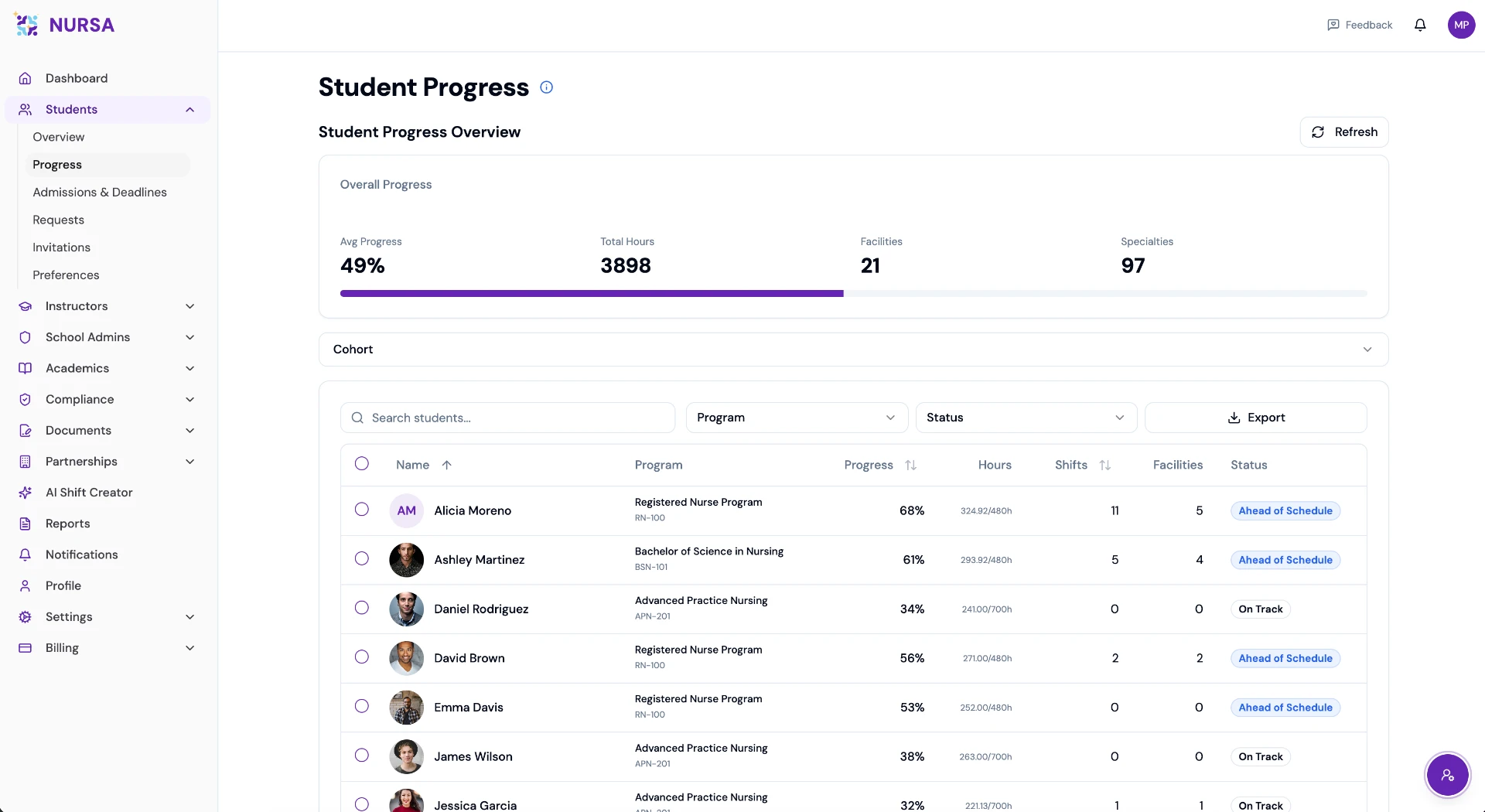
The live product supports clinical shift assignments, student cohorts, compliance requirements, credentials, partnerships with healthcare facilities, clinical-hour tracking, and reporting. Nursa’s public administrator documentation also describes permission levels, bulk student imports, compliance review, facility requirements, and an AI-assisted shift creator.
This matters because the weekend build was not simply a landing page. According to both Nursa and Lovable, the initial product included an interactive placement scheduler, portals for nursing students and university administrators, and a credential-tracking dashboard.
Watch Nursa Study in Action
Introducing Nursa Study. This official product video is also featured on Nursa’s website and shows how the platform coordinates clinical education workflows.
The Product Problem Came Before the AI Tool
The most important part of the Nursa story happened before anyone opened Lovable. Nursing schools had already been asking Nursa for a product designed around clinical education. The demand was not invented to justify using an AI tool.
Nursa already operated a healthcare staffing marketplace connecting facilities with nurses and caregivers. That gave the company relevant domain knowledge, established workflows, and an understanding of real-time scheduling. Schools were asking for a related experience built around students, clinical placements, credentials, and program administration.
Lovable accelerated a validated opportunity. It did not replace the work of discovering whether the opportunity existed.
This distinction is essential for product designers. AI can generate screens, code, and interactions quickly. It cannot independently determine whether a problem is valuable, whether the team understands it correctly, or whether the proposed experience fits the organization’s strategy.
How the Lovable AI App Was Built in 48 Hours
Before the weekend build, Nursa tested the same product concept across more than ten AI-building platforms. Lovable AI produced the strongest result, so the team used it to explore whether a complex healthcare workflow could become a working product in only two days.
By the end of the weekend, Nursa had a working MVP with an interactive shift scheduler, separate portals for students and administrators, and a credential-tracking dashboard.
The public accounts use unusually strong language. Lovable describes the result as a working product that could have been shown to a university immediately, while Nursa says the product launched only days later. These are company-reported claims rather than an independent technical benchmark, but the live Nursa Study product and detailed support documentation provide evidence that the concept moved beyond a disposable demo.
From Lovable AI MVP to Enterprise Product
The phrase “built in one weekend” is accurate only when the next phase remains visible. After the initial MVP, Nursa spent approximately two more weeks developing Nursa Study into an enterprise-grade product.
That stage included customer feedback, accessibility work, and production review. Lovable’s account describes university customers raising workflow and compliance requirements, with changes implemented between meetings instead of entering a backlog for months.
One example is especially relevant to UX professionals. When a school raised the need for full WCAG accessibility standards during a Friday meeting, Lovable’s case study says the change was available by Monday. Speed made the feedback loop shorter, but an accessibility requirement still had to be recognized, interpreted, implemented, and verified.
The weekend created the product proof. Customer feedback and enterprise review created the product confidence.
Why This Is a Product-Design Story
The most valuable part of the Nursa case is not the number of hours. It is the changing relationship between product intent and working software.
Traditional product teams often communicate a new concept through research summaries, requirements, wireframes, polished screens, and tickets before customers can interact with realistic behavior. Each handoff can introduce delay or lose context. A functional AI-built product gives the team a shared object that can be used, questioned, and revised.
This does not make wireframes or design systems irrelevant. It changes when the team needs each artifact and how much evidence it can collect before committing to a direction.
What Product Designers Should Learn from Nursa
1. Start with the workflow, not the visual style
Nursa Study solved a coordination problem involving placements, eligibility, credentials, cohorts, instructors, facilities, and students. A prompt asking for a “modern nursing dashboard” would not contain enough product logic. The value lives in the relationships, roles, rules, and states.
2. Domain expertise improves AI output
The build did not begin without context. Nursa already understood healthcare staffing, real-time scheduling, and the needs emerging from its customers. Lovable shortened implementation, but the input still carried years of product and domain knowledge.
3. Functional prototypes create better feedback
A university can respond more meaningfully to a working placement scheduler than to a static dashboard. Real interaction exposes sequence, terminology, permissions, missing states, and operational constraints.
4. Speed increases the importance of judgment
A polished build can create false confidence. Product designers still need to separate generated assumptions from validated requirements and production decisions. The faster an interface becomes convincing, the more disciplined the review must become.
5. Enterprise readiness is more than a successful demo
Healthcare and education products must account for privacy, security, accessibility, role-based access, auditability, data accuracy, support, and reliability. A 48-hour MVP can prove direction. It does not remove those responsibilities.
Build the workflow—not just another static screen
Use Lovable to turn a clear product brief into a functional experience you can review, share, and test.
What We Can—and Cannot—Verify Publicly
There is no public, frozen version of the original weekend prototype that readers can compare directly with the current enterprise product. The live experience is available through Nursa Study, but meaningful access requires an account or product demo.
What is public is substantial: Nursa’s newsroom identifies Lovable as the AI app builder, describes the original feature set, and says the product launched days later. Lovable provides a detailed customer case study. Nursa’s current product pages and administrator and student help guides document the live platform’s workflows.
For that reason, this article treats the speed and company outcomes as reported case-study evidence—not as an independent code, security, usability, or accessibility audit.
Lovable AI Does Not Eliminate the Product Designer
The Nursa case does not show that product design can be reduced to prompting. It shows what can happen when someone with product judgment gains direct access to working software.
Product designers still need to frame the problem, understand the users, map roles and workflows, define content, identify risks, test accessibility, expose edge cases, and decide what success means. Lovable can compress the production of an artifact. It cannot take responsibility for the quality or consequences of the product.
AI shortens the distance from product intent to working software. It does not shorten the distance from assumption to truth.
What Nursa’s Story Really Shows
The interesting part of Nursa Study is not simply that it was built over a weekend. Nursa already knew schools wanted the product and understood the workflows well enough to turn that need into something usable.
Lovable AI made the first build happen unusually fast. The real progress came next: putting it in front of schools, hearing what was missing, and improving the product while those conversations were still fresh.
That is where I see the value for product designers. It gives us a faster way to make an idea tangible, but we still have to ask the right questions, notice what does not work, and decide what deserves to become part of the final product.
Frequently Asked Questions
Was Nursa Study really built with Lovable AI?
Yes. Both Nursa and Lovable state that Lovable AI was used to build the initial Nursa Study product. Nursa’s current platform and public help documentation show that the product progressed beyond the original experiment.
Was the entire enterprise product finished in 48 hours?
The reported weekend result was a working MVP with a scheduler, student and administrator portals, and credential tracking. Lovable says the next two weeks were used to turn it into an enterprise-grade platform. Ongoing product development should be expected after both stages.
Can I view the original Lovable prototype?
A public, frozen copy of the original weekend prototype does not appear to be available. Readers can explore the current Nursa Study product page, its public help guides, and the sign-up or demo options.
Can product designers use the Lovable AI app builder without coding?
The Lovable AI app builder is designed to create working web products from natural-language direction, making it accessible to product designers and other non-engineering roles. Knowledge of responsive behavior, components, states, data logic, accessibility, and front-end structure still helps designers evaluate and refine the result.
Is a Lovable prototype ready for production?
Not automatically. Generated products still require appropriate product, design, accessibility, engineering, security, privacy, legal, and quality review. The level of review depends on the product and the sensitivity of its users and data.